


How many square metres does 1 gallon of paint cover? Work out your house paint in 5 steps, with real examples
Buy too little and you're dashing to the shop with paint on your hands. Buy too much and a tin sits under the stairs for ten years. Do five minutes of maths first, then buy the right amount in one go.

1 gallon of paint (3.785 litres) covers about 30–40 square metres per coat on a smooth, primed wall. Rough or absorbent walls get less. To work out how much paint you need, take the wall area minus doors and windows, multiply by the number of coats, divide by the paint's coverage rate, then add about 10% extra.
How many square metres does 1 gallon cover, and what does a pail of paint cover?
1 gallon (3.785 litres) of ordinary acrylic house paint covers around 30–40 square metres per coat on a smooth, primed plaster wall. Think of it like a car's fuel economy: you go further on a smooth road and less far on a dirt track. Rough walls, new plaster that soaks up paint, and porous exterior walls all use more.
As for a pail of paint, check the litres on the label first, because sizes vary by brand. The most common sizes are a small pail of about 9 litres and a large pail of about 18 litres, which work out at about 2.4 and 4.75 gallons respectively.
- Small tin, 0.946 litres (1/4 gallon): about 7.5–10 sq m per coat
- 1 gallon, 3.785 litres: about 30–40 sq m per coat
- 9-litre pail: about 71–95 sq m per coat
- 18-litre pail: about 143–190 sq m per coat
- With the standard 2 coats: the wall area you can actually finish is half the figures above

How to calculate house paint in 5 steps, with just a tape measure and a calculator
The standard paint system is 1 coat of primer and 2 coats of the paint itself. Calculate the paint and the primer separately, because you apply different amounts, and the primer is usually a different product from the paint.
The bonus of doing the maths yourself is that you'll understand a painter's quote too. If a painter tells you a small bedroom needs six gallons of paint, you'll know straight away to ask more questions.
- 1. Measure each wall: width × height, then add all the walls together (or use room perimeter × height)
- 2. Subtract openings: a standard door is about 1.8–2 sq m; measure each window, width × height
- 3. Multiply by the number of coats: 2 coats of paint, 1 coat of primer
- 4. Divide by the coverage rate: use the figure on the label, for example 30–40 sq m per gallon per coat
- 5. Add 10% extra: for spills, touch-ups, and keeping some for future repairs
- Ceiling: room width × length, calculated separately from the walls

Example 1: how many gallons for a 3 × 4 m bedroom?
A 3 × 4 m bedroom with a 2.6 m ceiling height, 1 door (0.9 × 2.0 m) and 1 window (1.2 × 1.2 m). The room perimeter is 3 + 4 + 3 + 4 = 14 m. Multiply by the 2.6 m height to get 36.4 sq m. Subtract 1.8 for the door and 1.44 for the window, leaving about 33 sq m of wall.
Paint, 2 coats: 33 × 2 = 66 sq m. Divide by 30–40 to get 1.65–2.2 gallons. Add 10% to get 1.8–2.4 gallons. For smooth walls, 2 gallons is enough. If the walls are rough, or you're going from a dark colour to a light one, allow 1 extra small tin.
Primer, 1 coat: 33 sq m divided by the rate on the primer label. If it's close to 30–40 sq m per gallon, you'll use about 1 gallon. The ceiling is 3 × 4 = 12 sq m; 2 coats makes 24 sq m, which uses less than 1 gallon. Buy 1 gallon and keep the rest for touch-ups.
- Walls: about 33 sq m, 2 gallons of paint (+ a small tin if the walls are rough)
- Primer: about 1 gallon (check the rate on the label)
- Ceiling: 12 sq m, 1 gallon of ceiling paint
Examples 2 and 3: a living room, and the front of a townhouse
A 4 × 5 m living room with a 2.7 m ceiling height, a 2.0 × 2.2 m sliding door and a 1.5 × 1.2 m window. The room perimeter is 18 m × 2.7 = 48.6 sq m. Subtract openings of 4.4 + 1.8 = 6.2, leaving 42.4 sq m. 2 coats makes 84.8 sq m. Divide by 30–40 to get 2.1–2.8 gallons, and with the extra that's 2.3–3.1 gallons. Buying 3 gallons is about right.
The front of a 2-storey townhouse, 5 m wide and 7 m high = 35 sq m. Subtract the 2.2 sq m door and 3 windows (1.5 × 1.2 = 1.8 each), 7.6 sq m in total, leaving 27.4 sq m. 2 coats makes 54.8 sq m, which needs 1.4–1.8 gallons, or 1.5–2.0 gallons with the extra. Exterior walls are usually rougher, so buy 2 gallons. If you're painting a back wall of a similar size too, that's about 4 gallons in total.
This is where pail size can save you money. For example, Voqe Wall Paint covers 35–40 sq m per gallon per coat. The 1-gallon size costs ฿1,299 and the 18-litre size (about 4.75 gallons) costs ฿3,990. If a job uses 4 gallons or more of a single shade, the large pail works out a good deal cheaper than buying separate gallons.
- 4 × 5 m living room, 2.7 m high: about 3 gallons
- 5 × 7 m townhouse front: about 2 gallons
- Townhouse front + back: about 4 gallons, or one 18-litre pail if it's all one colour
- Two-tone house: work out the area for each colour separately, and buy each colour separately
Quick chart: room size vs gallons of paint
If you don't feel like doing the maths, just use this quick chart. It assumes a 2.6 m ceiling height, 1 door and 1 window (about 3 sq m subtracted), 2 coats of paint, 10% extra, and a coverage rate of 30–40 sq m per gallon per coat. It counts the walls only, not the ceiling or primer.
If your room has a higher ceiling, large windows or sloping walls, the chart may be off. Go back to the 5 steps above. It takes less than five minutes.
- 3 × 3 m room: about 2 gallons
- 3 × 4 m room: about 2–2.5 gallons
- 4 × 4 m room: about 2–3 gallons
- 4 × 5 m room: about 3 gallons
- 5 × 6 m room: about 3–4 gallons
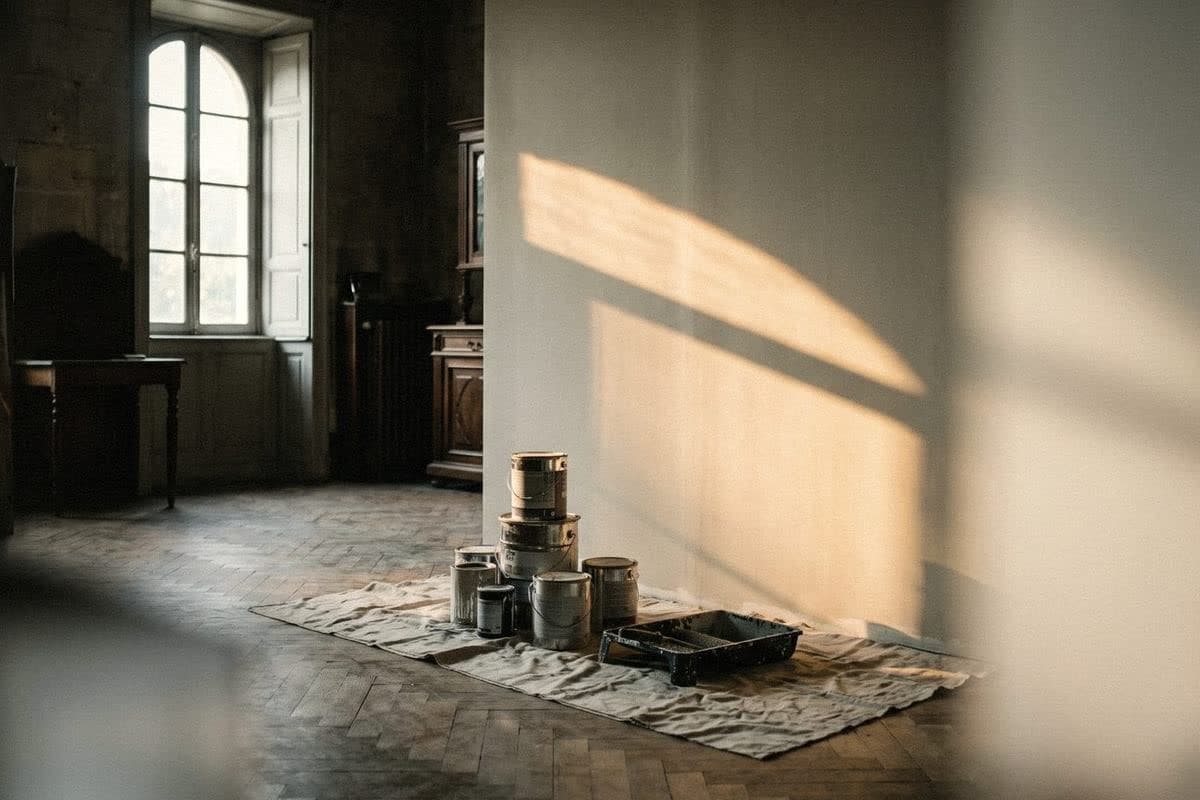
Calculating mineral paint in litres: one feature wall
Textured paint applied with a brush is calculated differently from house paint, because it's thicker and applied in criss-cross layers. Voqe Mineral Finish covers 8–12 sq m per litre per coat, depending on the wall surface and the hand applying it. The system is 1 coat of primer and 2 coats of Mineral Finish.
A headboard wall 3 m wide and 2.6 m high = 7.8 sq m. 2 coats makes 15.6 sq m. Divide by 8–12 to get 1.3–2.0 litres. Set 2QT (two tins, Light Shade and Shadow Shade) at ฿1,180 suits a wall this size if the wall is smooth. If the wall is 4 m wide or more, or you're doing more than one wall, move up to Set 2GL at ฿2,998.
- Formula: wall area × 2 coats ÷ 8–12 = litres needed
- 3 × 2.6 m wall: about 1.3–2.0 litres
- 4 × 2.7 m wall: about 1.8–2.7 litres
- Several walls in one room: add them up and choose the larger set, so the colour is more consistent

“Five minutes of maths beats a dash to the paint shop with paint still on your hands.”
Frequently asked questions
How many square metres does 1 gallon of paint cover?
1 gallon (3.785 litres) of ordinary acrylic house paint covers about 30–40 square metres per coat on a smooth, primed wall. With the standard 2 coats, that's about 15–20 square metres of finished wall.
How many square metres does a pail of paint cover?
Check the litres on the label. An 18-litre pail (about 4.75 gallons) covers about 143–190 square metres per coat, or about 71–95 square metres of wall in 2 coats. A 9-litre pail covers about half that.
How many gallons of paint for a 3 × 4 bedroom?
A 3 × 4 m bedroom with a 2.6 m ceiling has about 33 square metres of wall after subtracting the door and window. 2 coats uses about 2 gallons of paint and about 1 gallon of primer, plus another 1 gallon if you're painting the ceiling too.
How do I calculate how much house paint I need?
Measure the wall area, width × height for every wall, subtract doors and windows, multiply by the number of coats, divide by the coverage rate on the label, then add about 10% extra. Calculate primer and ceiling paint separately.
How much extra paint should I allow?
Allow about 10% for spills, touch-ups and keeping some for future repairs. Rough walls, new plaster, or going from a dark colour to a light one may need more than that.

Colour on a screen never matches colour on a wall
Order a sample to paint at home, or come and see the full shade library at Voqe Studio, Bang Phli.
Choose a shade and the right tin sizeRead next
Painting cost per square metre in 2026: what painters charge, and how to compare quotes without being overcharged
Painting labour isn't expensive or cheap because of the painter. It's because of the wall. Know what pushes the price up and you'll be able to read every line of a quote.
Read article
House paint prices: what does painting one room cost? Worked out line by line
No need to guess what one room will cost to paint. We work through every line for you, from square metres and litres down to the price of a roller.
Read article
Primer for old plaster vs primer for new plaster: how they differ and which to choose
Primer is your wall's make-up base. You can skip it, but the paint on top won't last. Find out whether your walls are old or new concrete, then choose the right one.
Read article